
Swarms of immature pink locusts and adult yellow locusts are currrently active. Not only are fresh locusts swarms expected to arrive in the coming weeks, but even those already present in India have mated and are breeding new offspring.
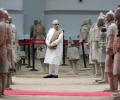
India, China must further strengthen business ties for growth.
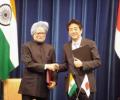
India's commitment to an open and plural security architecture attests to the fact that Asia's transition is a dynamic of both power & identity, says Zorawar Daulet Singh

'India appears to have stood its ground on strategic autonomy by resisting US pressure on Russia, China and Iran, but succumbed to the temptation to walk into a tighter embrace in defence cooperation, a high priority of the Trump administration,' notes Ambassador T P Sreenivasan.

The onus today is on China, but it also requires a little diplomatic finesse from India, backed by a modernised armed force, argues BJP MP Subramanian Swamy in this excerpt from his new book, Himalayan Challenge: India, China And The Quest For Peace.

It will not be to India's advantage to create misperceptions that it is bandwagoning with some Anglo-American project for regime change in Myanmar, argues Ambassador M K Bhadrakumar.

The IAF chief also said Pakistan has become a pawn of Chinese policy and its dependence on China would increase further in future. He said India needs to understand the interplay of some major events in its vicinity that would impact the security scenario of the region.

Swaraj expressed satisfaction over the agenda of the inaugural dialogue while giving the details of the deliberations.

India and Japan have a shared interest in countervailing China's hegemonic ambitions in Asia. Although neither has an interest in forming an overt anti-China alliance, Tokyo and New Delhi feel increasingly obligated to work together to find ways to guard against a muscular Beijing's power sliding into arrogance, says Brahma Chellaney.

India and China on Friday held 'in-depth' discussions on addressing the remaining issues along the Line of Actual Control (LAC) in eastern Ladakh, holding that disengagement in the North and South banks of Pangong lake provided a good basis to work towards their early resolution.

'It is crucial today to realise where we have reached in this 15 year-period in order to fully and properly assess the profundity of what General Rawat has said,' points out Ambassador M K Bhadrakumar.

Modi may take satisfaction from his display of considerable political skill in managing a mercurial, temperamental and unpredictable US president and nudging him into uncharacteristic restraint and even carefully orchestrated remarks. This personal chemistry will come in handy if Trump returns as president in the November elections, says former foreign secretary Shyam Saran.

'China's excessive military aid to Pakistan is the real elephant in the room as far as Sino-Indian relations are concerned. India should be confident enough to accept a degree of closeness between China and Pakistan, since China may wish to use this link for its foray into the Muslim world.' 'But the Chinese must be realistic enough to know that as time passes, the tactic of using Pakistan as a proxy to check India will yield diminishing returns. The US tried it for 60 years but failed, so will China,' says Colonel Anil A Athale (retd).

The arrival a couple of days ago of a Chinese nuclear submarine for the first time in Karachi port, coinciding with a Chinese military delegation's visit, points to Pakistan's importance for China, says former R&AW officer Jayadeva Ranade.

India, Japan and the Unoted States on Friday kicked off their marine war games, Malabar Exercise, close to the South China Sea as they focus on deeper military ties and greater interoperability amid rising tensions in the region.

The PM's vision of a lean, agile, mobile and technology driven force requires more than 1.7 percent of GDP that it now gets.

These natural wonders are all under threat.
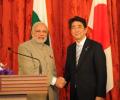
India and Japan are natural partners at sea, and Narendra Modi's recent visit underlined the need to keep the association going

Brushing aside India's concerns, China on Monday cemented its "all-weather ties" with Pakistan by agreeing to build a strategic $46 billion (Rs 2.9 lakh crore) economic corridor through Pakistan-occupied Kashmir as part of 51 deals signed, expanding the communist giant's influence in the region.

'Over the last two decades, the India-French relationship has grown steadily, no major political difference having darkened the sky between Paris and Delhi,' says Claude Arpi.

ADB has often expressed its interest in promoting sub-regional integration in South Asia and perhaps could be involved as a facilitator.

Officials in the weather department said the monsoon is expected to be below normal because of the El-Nino effect.

'While visits and personal meetings are useful, changes of strategic significance have occurred recently, with Beijing trying to take the lead which Modi must take note of.'

The news of the week gone by that shaped the world

We have our own problems for sure and they are not trivial, but for now, our economy is in not too bad a shape, our politics is as personality-driven and authoritarian as that of most countries in the world. We must make the best of what we have and not be excessively unhappy looking at the grass on the other side of the septic tank which may not be greener after all!, observes Shreekant Sambrani.

Starting this December, for the first time ever, travellers will be able to embark on a cruise from India.

'We need to retell this history from many different perspectives.'

'This is the first time that the Americans have agreed to refer to "cross-border terrorist attacks" in a joint statement.' 'No wonder Pakistan has called the joint statement "singularly unhelpful" and has blasted it, and its all-weather friend China has applauded Pakistan's frontline role in combating terrorism,' points out former foreign secretary Ambassador Kanwal Sibal.

Indians at large harbour a notion that their country is cherrypicking out of the American basket of goodies, but the policymakers in Delhi and the political leadership are well aware that it can only be a pipe dream since a military alliance with a superpower is a profound irrevocable commitment, observes Ambassador M K Bhadrakumar.

Prime Minister Narendra Modi this month will be undertaking one of the longest ever abroad visits by an Indian head of government in recent times. He is scheduled to be on a nine-day, three-nation visit to Myanmar, Australia and Fiji from November 11 to 19. Later in the month, he will be in Nepal to attend the South Asian Association for Regional Cooperation summit on November 26-27.

'He was always opposed to a form of nationalism that was narrow, selfish and arrogant.' 'He will always remain a beacon of inspiration for freedom-loving people across the world and for movements of resistance against oppressive State power.'
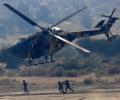
'Given the present force levels, India cannot fight and win.' 'India can't hope to terminate the conflict on India's terms and impose the nation's will upon the adversaries,' says Brigadier Gurmeet Kanwal (retd).

We are all 'Chasing the Monsoon', notes Ajit Balakishnan.

'We need to be in a perpetual state of aggression, and able to swiftly change the goal posts to keep Pakistan in a state of imbalance,' argues Sanjeev Nayyar.

More than 3,000 squads under health and local self-government departments have started the process of cleaning houses and public places, official sources said.
The IMD chief also allayed fears of occurrence of an El-Nino.
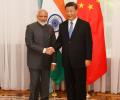
'The fact that Modi and Xi exuded confidence to accelerate the negotiations for a border settlement alone underscores that the Russia-India-China triangle has become very dynamic,' notes Ambassador M K Bhadrakumar.

It is time to throw an outer ring around India's national security by proactively engaging in areas immediately outside our neighbourhood. Such a ring will not only insulate India from emerging threats, but also create new leverage in securing our own neighbourhood, says Nitin Pai.

'The creation of Pakistan was integral to Britain's grand strategy.' 'If they were to ever leave India, Britain's military planners had made it clear that they needed to retain a foothold in the NWFP and Baluchistan because that would provide the means to retain control of Iran, Iraq, Kuwait, the UAE, Bahrain and Qatar.'

Here's the full text of Prime Minister Narendra Modi's address to the United States Congress.
